
Hydrovane Fixed Speed
Showing 33–42 of 42 resultsSorted by popularity
-

Hydrovane HR07E – 10 – Fixed Speed Rotary Vane Compressor
£7,600.00 excl. VAT Add to basket -
Hydrovane HR07E – 07 – Fixed Speed Rotary Vane Compressor
£7,600.00 excl. VAT Add to basket -

Hydrovane HR05E – 10 – Fixed Speed Rotary Vane Compressor
£7,100.00 excl. VAT Add to basket -
Hydrovane HR05E – 07 – Fixed Speed Rotary Vane Compressor
£7,100.00 excl. VAT Add to basket -
Hydrovane HR04E – 10 – Fixed Speed Rotary Vane Compressor
£6,700.00 excl. VAT Add to basket -
Hydrovane HR04E – 07 – Fixed Speed Rotary Vane Compressor
£6,700.00 excl. VAT Add to basket -

Hydrovane HR07 PR – 07 – Fixed Speed Rotary Vane Compressor
£7,100.00 excl. VAT Add to basket -
Hydrovane HR05 PR – 10 – Fixed Speed Rotary Vane Compressor
£6,700.00 excl. VAT Add to basket -
Hydrovane HR05 PR – 07 – Fixed Speed Rotary Vane Compressor
£6,700.00 excl. VAT Add to basket -
Sale!

Hydrovane HV02 Tripod 2.2kW 1ph Single Phase Fixed Speed Rotary Vane Compressor
Original price was: £3,620.00.£2,534.00Current price is: £2,534.00. excl. VAT Add to basket
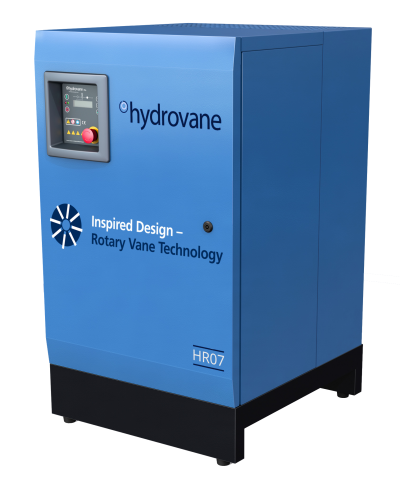

How Rotary Vane Compression Works
Inside a Hydrovane compressor, a rotor sits eccentrically inside a cylindrical stator. Vanes slide in and out of slots in the rotor under centrifugal force as the rotor turns, creating cells between the rotor, stator and adjacent vanes. As the rotor continues to turn, the cells decrease in volume and the air inside is compressed. Oil is injected during compression to cool, seal and lubricate, and is removed in the oil separator before the air exits.
The key characteristic of this design is its operating speed. Hydrovane compressors are designed to operate at low rotational speeds compared with many compressor technologies, helping reduce noise, vibration and mechanical stress. Slow speed means lower stress on all internal components, lower noise levels, less vibration, and an airend that wears in gradually rather than degrading rapidly. Correctly serviced with genuine parts, a Hydrovane airend routinely exceeds 100,000 operating hours.
Smooth, Pulse-Free Compressed Air with Low Oil Carry-Over
Hydrovane compressors deliver smooth, pulse-free compressed air. Where a defined dewpoint or air quality class is required, Air Energy can specify the correct receiver, dryer and filtration package. Oil carry-over is typically less than 3 ppm. Because the output is smooth and continuous – without the pressure pulses characteristic of piston compressors – a receiver is not normally required simply to smooth the air supply. However, a receiver may still be recommended for storage, intermittent demand, system buffering or specific downstream equipment. For applications where space is limited or installation needs to be straightforward, this simplifies the system considerably.
Hypac packages, which combine the compressor with a receiver and refrigerant dryer in a single unit, are available in the HV04 to HV22 range.
The Hydrovane Fixed Speed Range
Well known for their reliability, the fixed speed Hydrovane range runs from HV01 at 1.1 kW to the HV55 and HV75 at the top of the range, available in vertical enclosed ACE format and horizontal open PEAS format depending on the model.
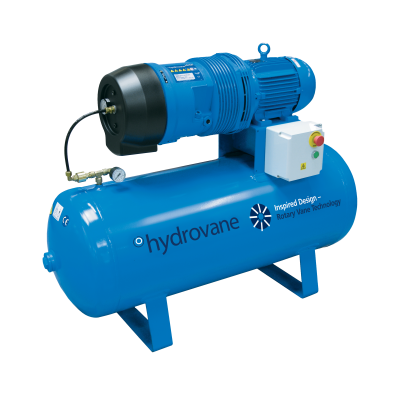
- HV01-HV04 (1.1-4 kW): Compact open-format units for workshops, dental practices, automotive garages and light industrial use. Tripod or receiver-mounted. Very low noise making it suitable for point-of-use installation.
- HV05-HV22 (4-22 kW): Vertical enclosed ACE format. Quiet enough for office-adjacent or workshop floor installation. Hydrovane Pro controller fitted as standard. Hypac packaging available.
- HV30-HV45 (30-45 kW): Available in both ACE vertical enclosed and PEAS horizontal open formats. Suited to medium industrial applications with continuous duty requirements.
- HV55-HV75 (55-75 kW): Larger horizontal enclosed ACE units for high-output operations. Auto-idle load management system fitted as standard.
Not sure which Hydrovane model is right for your site? Air Energy can assess your air demand, duty cycle, installation location, noise constraints and downstream treatment requirements before recommending the right fixed speed compressor configuration – whether that is a standalone unit, receiver-mounted model or Hydrovane Hypac system.
For sites that need stored and dried compressed air, Hydrovane Hypac systems combine the compressor with an integrated receiver, refrigerant dryer and filtration options in one compact unit. They are available across selected HV04 to HV22 models.
Advance 10 Warranty and Authorised Hydrovane Service
Hydrovane’s Advance 10 warranty programme provides extended cover for eligible compressors from 4 kW to 75 kW, including up to 10 years or 48,000 operating hours on the airend and a lifetime guarantee on cast iron vane blades, subject to programme terms.
To maintain cover, compressors must be installed, serviced and maintained in line with Hydrovane requirements, using genuine parts and lubricants.
Air Energy is an authorised Hydrovane distributor and service partner. Compressor service and maintenance is carried out by our engineers using genuine Hydrovane parts, helping eligible compressors remain aligned with Advance 10 requirements. We cover Hertfordshire, Greater London, Buckinghamshire, Bedfordshire, Essex and Cambridgeshire.
Speak to an Engineer
Not sure which Hydrovan Compressor model is right for your application?
Request a Hydrovane Compressor Recommendation Or call 01992 238 339 to discuss whether regulated speed is right for your site.
FAQs
What is a Hydrovane compressor?
A Hydrovane is a rotary vane air compressor – a type of positive displacement compressor that uses sliding vanes in an eccentrically mounted rotor to compress high quality air. Unlike a rotary screw compressor, which uses two interlocking helical rotors, a Hydrovane uses a single rotor and vanes. The design has fewer moving parts, operates at slow speed (around 1,450 rpm) and produces continuous, pulse-free compressed air flow. Hydrovane compressors are made in the UK and are owned by the Gardner Denver group.
How long does a Hydrovane compressor last?
A correctly maintained Hydrovane compressor will routinely exceed 100,000 operating hours. At 8 hours per working day, that represents over 40 years of daily use – significantly longer than most rotary screw compressors in equivalent applications. The reason is simple: the design operates at low speed, reducing mechanical stress on all components. The main wear item is the cast iron vane blades, which Hydrovane guarantees for life when the compressor is maintained on the Advance 10 programme.
How quiet is a Hydrovane compressor?
Noise levels on Hydrovane fixed speed models start at 62 dB(A) in open format – comparable to a normal conversation. Enclosed ACE format models are quieter still. The combination of slow operating speed and the smooth, continuous nature of vane compression means Hydrovane compressors are among the quietest industrial compressors available at equivalent power levels. This makes them practical for installation at the point of use without requiring a separate compressor room or acoustic enclosure.
Does a Hydrovane compressor need a receiver?
Not as standard. Because Hydrovane air output is continuous and pulse-free, a receiver is not required simply to smooth the air supply – the compressor delivers stable pressure directly. A receiver is useful where you need to store air for intermittent high-demand events that exceed the compressor’s output rate, or where the system needs a buffer during start-up. Air Energy can advise whether a receiver adds operational value in your specific application and can supply receiver-mounted configurations across the smaller model range.
What is the Hydrovane Advance 10 warranty?
Hydrovane’s Advance 10 warranty programme provides extended cover for eligible compressors from 4 kW to 75 kW, including up to 10 years or 48,000 operating hours on the airend and a lifetime guarantee on cast iron vane blades, subject to programme terms.
To maintain cover, compressors must be installed, serviced and maintained in line with Hydrovane requirements, using genuine parts and lubricants.
Air Energy is an authorised Hydrovane distributor and service partner. Our engineers can supply, install, commission and maintain Hydrovane compressors, with documented service records and genuine parts used as standard.
What is the difference between the Hydrovane HV open and ACE enclosed formats?
Open format (PUAS/PEAS) compressors are unenclosed – the mechanical components are exposed. They are suitable for installation in a dedicated compressor room or external plant room where noise control is handled by the building. ACE enclosed models have a sound-insulating enclosure and are designed for quieter operation in workshop, production floor or office-adjacent settings. ACE models are typically the right choice when the compressor needs to be sited near personnel or where local noise levels are restricted.
Can I use a Hydrovane compressor for dental or medical applications?
Hydrovane fixed speed compressors are widely used in dental practices and medical facilities. The quiet operation, compact footprint and oil-lubricated air quality (typically less than 3 ppm oil carry-over) make them practical for these environments. Call us on +44 (0)1992 238 339 for advice on the correct system specification for dental or medical compressed air, including the appropriate downstream treatment equipment.