For further assistance
Call us on 01992 238 314
Or email us on [email protected].
We work with a portfolio of leading manufacturers to support the right system for your site.

Where compressed air is used to supply respiratory protective equipment, it is not simply a utility. It is part of your workforce’s safety protection.
It is air that people rely on to breathe.
A compressor may appear to be running normally, but the air supplied at the point of use can still be affected by oil, water, carbon monoxide, carbon dioxide, poor intake-air conditions, ageing filters or contamination within pipework. Regular breathing-air quality testing provides the evidence that your supplied air is suitable for the people relying on it.
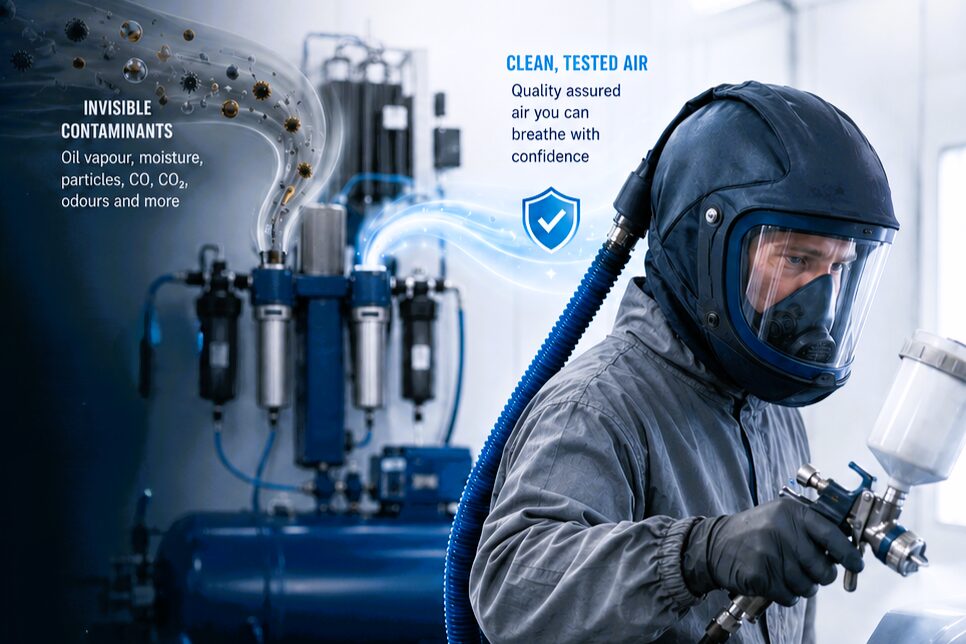
Compressed air used for tools, controls or production machinery does not necessarily require the same quality as air supplied to breathing apparatus.
Where people use air-fed masks, visors, hoods, helmets or airline breathing apparatus, the supplied air must be suitable for breathing. Contamination can create serious health risks and leave employers unable to demonstrate that their respiratory-protection controls are effective.
Testing helps you:
Testing should be considered wherever compressed air is supplied directly to people through breathing apparatus or air-fed respiratory protective equipment.
This includes sites involved in:
Air-fed respiratory protection is commonly used in spray booths and paint applications, particularly where isocyanate-containing coatings are used.
Spray-painting environments can present a higher risk of contamination entering the breathing-air supply, particularly where compressor intake conditions and maintenance are not tightly controlled.
Blast operators may rely on airline-fed helmets and hoods for respiratory protection.
Operations involving coatings, chemicals, dust, fumes or airborne contaminants may use supplied-air respiratory protection.
Any application using compressor-supplied breathing apparatus should be assessed to confirm the air supply is suitable and appropriately tested.
Employers have legal duties under the Control of Substances Hazardous to Health Regulations 2002 (COSHH) to prevent or adequately control employee exposure to hazardous substances.
Where respiratory protective equipment is used as part of those controls, it must be suitable, properly maintained and capable of protecting the wearer.
For compressed breathing air, the recognised technical standard is BS EN 12021:2014 – Respiratory equipment: compressed gases for breathing apparatus.
This standard sets quality requirements for compressed breathing air, including limits and controls around contaminants such as:The standard covers core aspects of breathing-air quality including:
 Oxygen content
Carbon monoxide
Carbon dioxide
Oil content
Water content / dew point
Odour and taste
Where a site risk assessment identifies further potential hazards – such as vehicle exhaust, solvent vapours or process emissions near the compressor intake – the appropriate additional testing should also be considered. The exact testing programme should reflect your risk assessment, equipment, operating environment and maintenance regime.
Contamination is not always visible, audible or obvious.
It can enter the system through the compressor intake, during compression, through inadequate treatment, or further downstream in storage, pipework and point-of-use equipment.
Common risks include:
The critical question is not simply whether the compressor has been serviced.
It is whether the air reaching the person wearing the mask, hood or helmet is suitable to breathe.
Breathing-air quality testing should be carried out at intervals determined by risk assessment.
As a general benchmark, HSE guidance indicates that air supplied to breathing apparatus should normally be tested at least every three months.
More frequent checks may be appropriate where:
For some higher-risk vehicle spray-painting environments, monthly breathing-line checks may be required.Your testing programme should reflect the site’s risk assessment, the application and the equipment in use.
Breathing-air quality is affected by the entire system:
Intake air → compressor → air treatment → storage → distribution → point of use → respiratory equipment
A standard workshop compressor may be part of a suitable breathing-air arrangement, but it should never be assumed that ordinary process air or a general factory outlet is safe for respiratory use.
The system needs the right intake location, treatment, maintenance, testing and controls for the application. HSE guidance makes clear that breathing apparatus requires a supply of breathing-quality air from an independent source, such as an air cylinder or compressor.
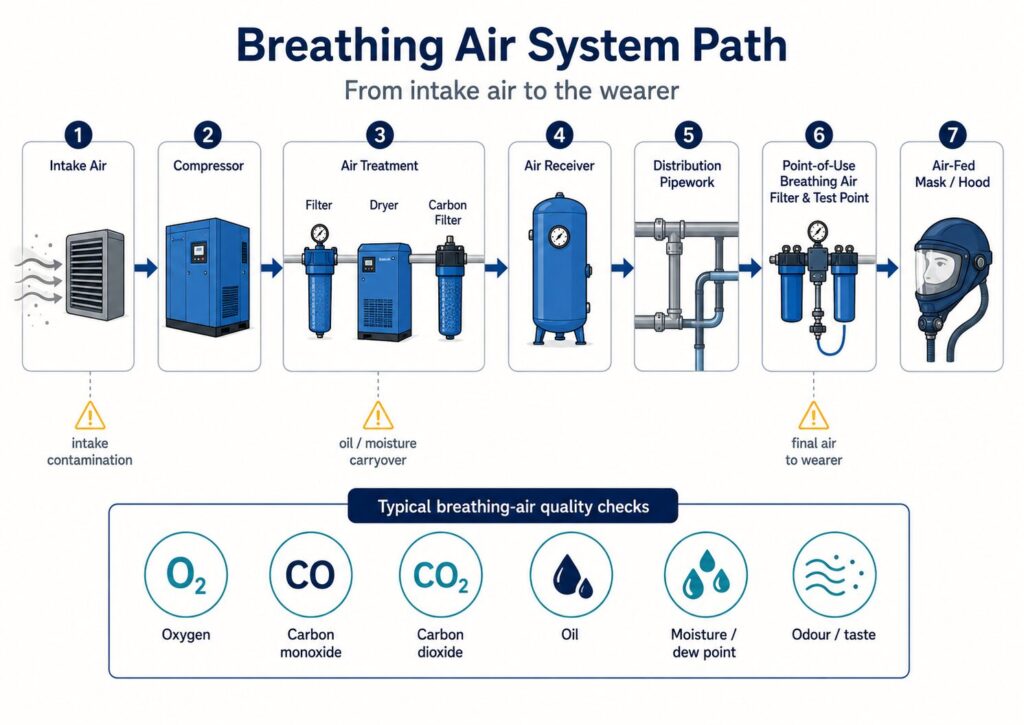
Illustrative breathing-air system path. System design and testing requirements vary by application and risk assessment.
Air Energy helps businesses take a practical, documented approach to breathing-air safety.
Our breathing-air support can include:
Sampling and testing of compressed air used for breathing apparatus, helping you understand whether the supply is performing as intended.
Clear records to support your internal maintenance programme, COSHH assessment and audit trail.
Assessment of the wider breathing-air system, including compressor condition, intake location, filtration, drying, drains, pipework and point-of-use equipment.
Where results identify a problem, our engineers can advise on and implement the appropriate corrective action — from filtration and dryers to compressor servicing, drainage improvements or intake-air changes.
Scheduled testing and maintenance support to help keep your breathing-air system under control over time.
A compressor service is important, but it does not replace breathing-air quality testing.
The only way to demonstrate that the air supplied to your team is suitable for breathing is to test it, record the result and act on any issues found.
Air Energy can help you assess and test compressed air supplied to respiratory protective equipment, including air-fed masks, hoods, helmets and breathing apparatus.
RISING ENERGY COSTS
Compressed air can be one of the most energy-intensive utilities on an industrial site. Air Energy helps customers identify where energy is being used, where waste may be occurring and where system improvements could reduce running costs.
AIR LEAKS & WASTED AIR
Leaks, pressure drops and inefficient system demand can quietly waste energy every day. Through air leak detection, data logging and system reviews, Air Energy helps sites identify avoidable losses and improve compressed air efficiency.
UNPLANNED DOWNTIME
When compressed air systems fail, production can quickly be affected. Air Energy supports industrial sites with servicing, repairs, maintenance planning and responsive engineering support to help protect uptime.
POOR AIR QUALITY OR MOISTURE
Moisture, oil, particles and poor filtration can affect equipment performance, product quality and downstream processes. Air Energy helps specify and maintain dryers, filters and air treatment systems to support cleaner, drier and more reliable air.
AGEING COMPRESSORS
Older compressors may still run, but they can become less efficient, less reliable and more expensive to maintain. Air Energy helps assess whether servicing, repair, upgrade or replacement is the best route for long-term performance.
COMPLIANCE & SAFETY REQUIREMENTS
Many industrial environments need systems that support safety, quality and compliance requirements. Air Energy provides engineering support across areas such as breathing air quality, filtration, maintenance records and system reliability.
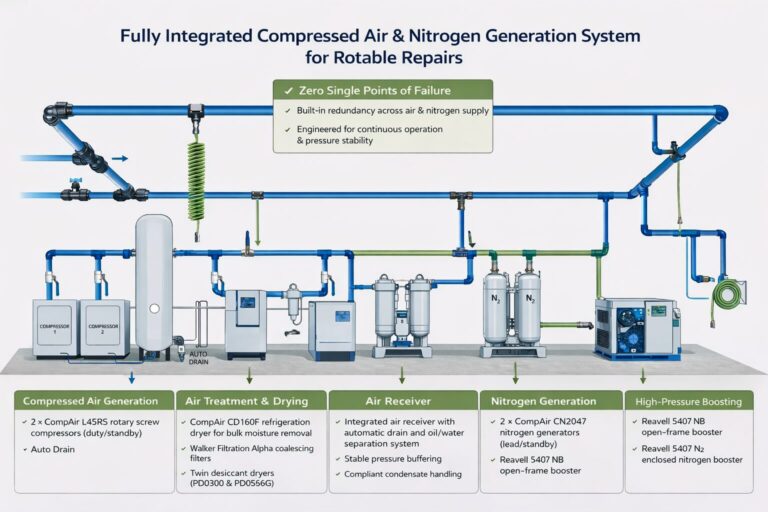
Futureproofing aircraft tyre refurbishment with a fully integrated air & nitrogen system

On-Demand Compressed Air for BBC Studios at Elstree Film Studios
We design, deliver and support integrated compressed air, vacuum and nitrogen systems for industrial operations across Hertfordshire, the South East and East Anglia. From initial specification through to long-term maintenance, we take responsibility for performance, reliability and compliance.
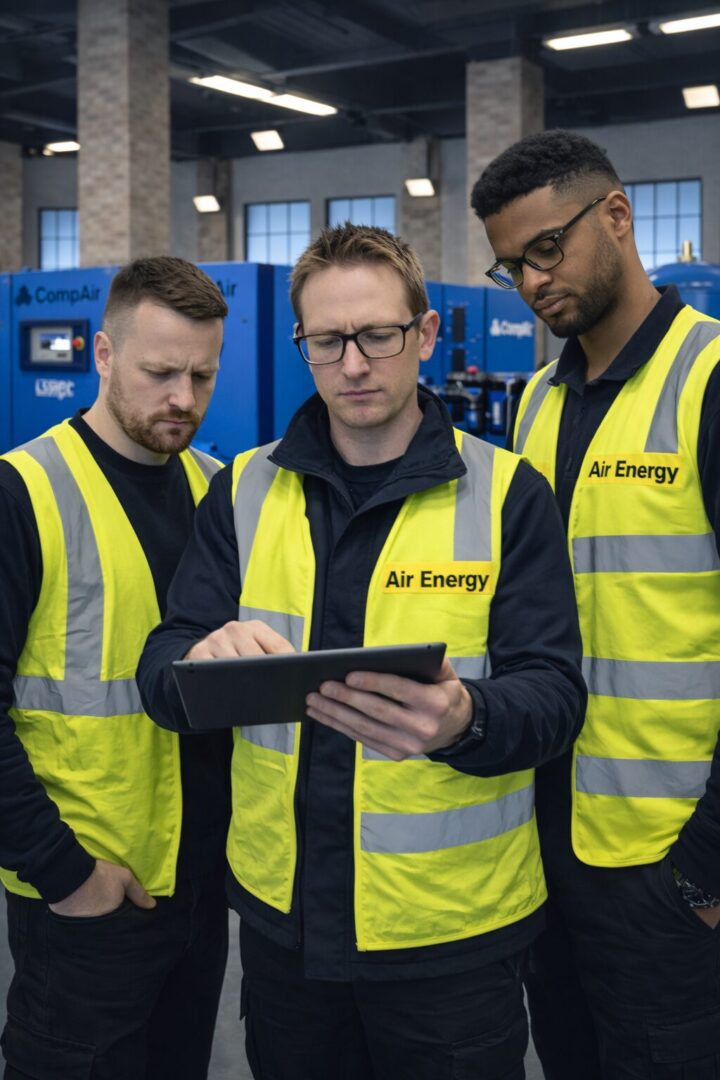
Integrated compressed air, vacuum and nitrogen systems designed, installed and commissioned for reliable site performance:
☑ Full system specification and sizing
☑ Pipework and control integration
☑ Mechanical and electrical installation
☑ Turnkey project delivery
☑ Commissioning and performance validation
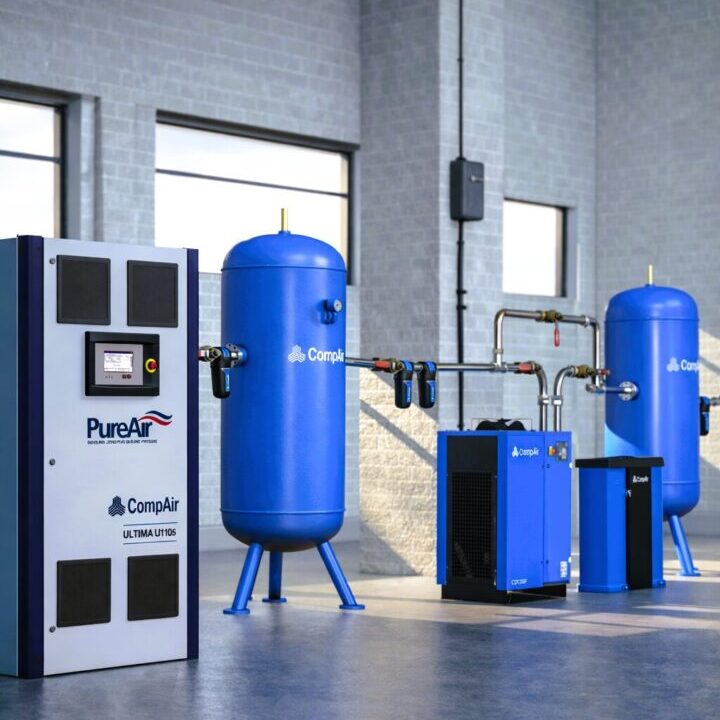
We supply compressed air, vacuum and nitrogen products, parts and consumables from leading manufacturers, supporting customers in the UK and overseas with reliable fulfilment.
☑ Compressors and vacuum pumps
☑ Air treatment and filtration systems
☑ Nitrogen generation
☑ Genuine parts, oils and service kits
☑ UK and international product supply
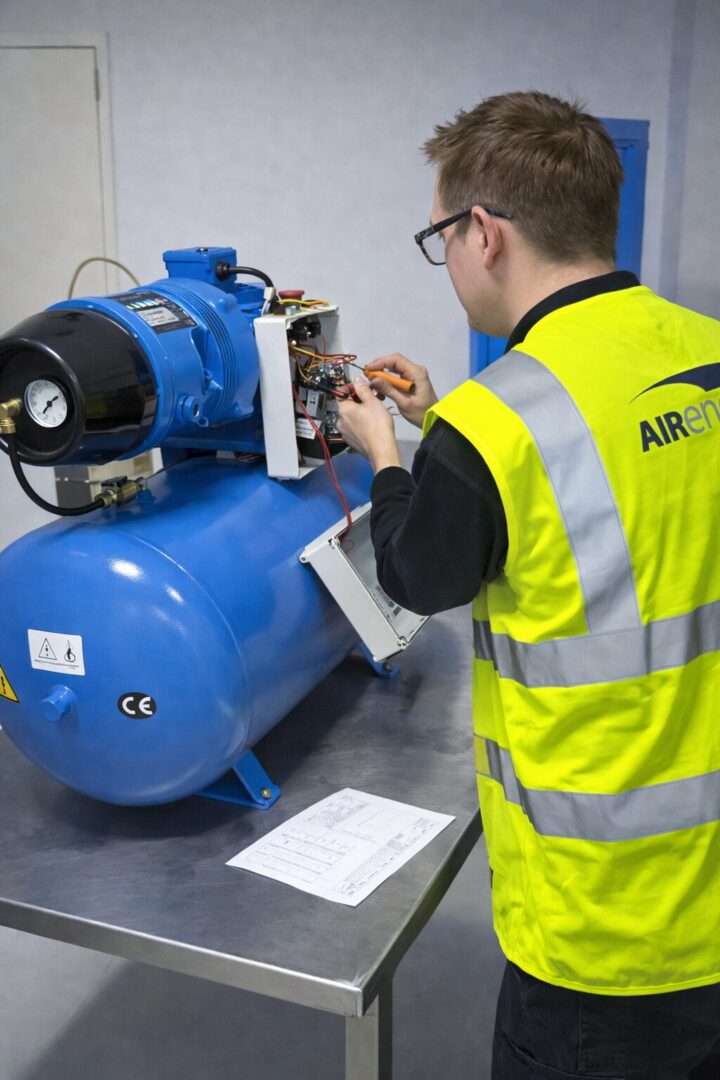
Proactive servicing and diagnostics to maximise uptime, efficiency and system lifespan. Our focus is long-term system reliability, not reactive repair:
☑ Planned preventative maintenance
☑ 24/7 emergency breakdown support
☑ Breathing air quality testing
☑ Energy efficiency and air leak audits
☑ Genuine parts and consumables
Call us on 01992 238 314
Or email us on [email protected].
We work with a portfolio of leading manufacturers to support the right system for your site.

Practical guidance on reliability, efficiency and compliance for compressed air, vacuum and nitrogen systems.

Enter your details below to save your shopping cart for later.